Conner Laugh · Bub's Pressure Washing
Veteran-owned, licensed & insured · Published July 23, 2026
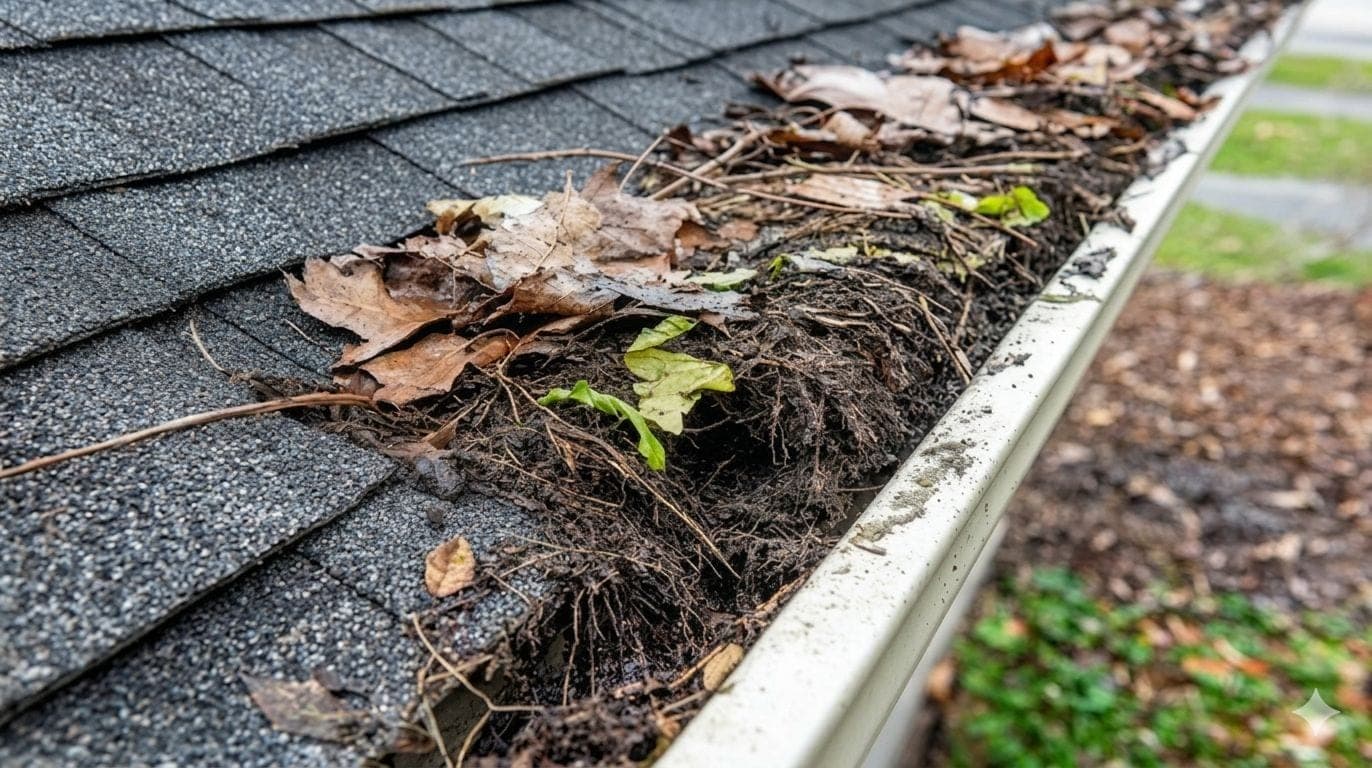
Every year it is the same pattern. A big line of storms rolls across the Midlands, and for the next week the calls all start the same way. Water poured over the front of the gutter, right over the door, down the wall, into the beds. And almost every caller says the same line. But they looked clear.
They probably did look clear. That's the trap.
Why gutters overflow when they look clean
A gutter system is a trough and a drain. Everybody checks the trough. Almost nobody checks the drain, and the drain is where the system actually fails. The elbow at the top of each downspout is the tightest turn in the whole run, and it is where wet leaves, shingle grit, and pine needles jam first. Once that elbow packs, the downspout is a plug, not a drain. The trough above it can be spotless and the system still cannot move water.
In a drizzle, nothing happens, and the problem stays invisible. In a real Carolina downpour, the run fills in minutes, and the water goes over the front edge in a sheet. The gutters that fail in a storm are almost never the ones that look full. They are the ones that look fine.
When gutters overflow but are not clogged
Sometimes the system really is clear and the water still comes over. When gutters overflow but are not clogged, the usual suspects are lost pitch, a sagging section holding water, or a roof valley dumping more rain into one stretch than it can carry. An undersized gutter does the same thing, but only in the hardest rain. We check pitch, sag, and hangers on every walk-around. If the fix is an adjustment and not a cleaning, we will say so, because a clean-out cannot cure a pitch problem.
What a season of overflow does to a house
One overflowing storm makes a mess. Let it repeat all season and the water starts doing real damage, in places homeowners rarely connect to gutters until later.
The fascia boards behind the gutter take it first. They are wood, the overflow wicks in behind the gutter back, and rot gets going where nobody can see it. The run below takes it next. Water pounding off an edge all season trenches the mulch, splatters soil up the wall, and drowns whatever was planted there. And all of that water lands next to the slab or crawlspace instead of draining away from it, which is exactly where you do not want a summer of storm water going.
None of this shows up on a sunny day. Here is the quick read for the next hard rain:
| What you see | What it usually means | The move |
|---|---|---|
| Water sheeting over the front edge in rain | Packed elbow or downspout, even if the trough looks clear | Full clean-out with every downspout flushed |
| A trench or splash line in the beds under a run | That section has been overflowing for a while | Clean-out, then check the fascia behind it |
| A sagging stretch of gutter | Packed debris weight pulling the hangers | Clean-out soon, before the hangers give |
| Overflow at one corner only, even after a cleaning | A roof valley concentrating water, or a low spot in the run | Walk-around check of pitch and hangers, not just another clean-out |
| Black stripes down the gutter faces | Oxidation in the finish, not dirt | A separate brightening treatment, not a cleaning |
Rather leave it to a pro?
We will read it in person and tell you exactly what it needs. Veteran-owned, free estimate, no trip fee.
GET MY FREE ESTIMATECan a leaf blower clean your gutters?
A leaf blower run along the roof edge is the popular shortcut, and it cannot fix the storm problem. It's fast, and it makes an impressive cloud. But it fails the system twice. It scatters debris across the roof, the yard, and places you will find for weeks. And it does nothing for the elbows and downspouts, because you can't blow a packed plug downward out of a pipe from above. Worse, it puts a homeowner on or near a roof edge for a job that mostly belongs on a ladder. The cloud looks like progress. The drain is still plugged.
What a real clean-out actually includes
A real clean-out is two jobs: scoop the troughs and prove the downspouts flow. The troughs get scooped by hand, into buckets, so the debris leaves with us instead of landing in the beds. Then every downspout gets flushed with water, and we watch for it to run out the bottom strong. That strong-flow check at the bottom is the entire point of the visit. An empty trough is not the finish line. The system is clean when water moves through every line the way the next storm will demand.
While we are up there we tell you what else we saw. Hangers pulling loose, a low spot holding water, fascia that has gone soft behind a chronic overflow. And if your gutter faces carry the black tiger stripes, the table above applies. That is a brightening job, not a cleaning, and we will say which yours needs on the walk-around.
The best time to clean gutters in South Carolina
Storm season here runs deep into fall, and the heavy leaf drop lands right in the middle of it. That makes this stretch of the year the worst time to be running on packed elbows and the best time to get ahead of it. The homes that ride out the fall fronts without a problem are the ones that got the system flowing before the weather showed up, not after the first overflow found the front door.
Fall is not the only load window either. The spring drop is quieter but just as real, stringy oak catkins and pine pollen that mat together in the trough and slide straight into the elbows with the first good rain. A system cleared in spring goes into storm season with its full capacity. One that skipped spring is already half loaded before the first leaf falls.
Tree cover is the multiplier. The oak-canopy streets around Forest Acres load gutters as hard as anywhere we work, with stringy catkins in spring and a heavy blanket in fall. The pine-shaded neighborhoods around Irmo pack needles into elbows nearly year round. If your lot looks like those, twice a year is just maintenance.
A clean-out is quick, it is not expensive relative to what fascia repair costs, and it is one of the few home jobs with a built-in test: the next storm either drains clean or it does not. If your gutters have not been touched since last year, or you watched water come over the edge in the last big rain, get a free quote and we will get every line flowing before the next front. And if those black streaks down the roof itself are what caught your eye, that is a different problem with its own fix, covered in our guide to black streaks on the roof.